
Why visit Tunisia?
Tunisia is a North African country on the Mediterranean, and it packs an unusual amount into a small space: some of the best-preserved Roman ruins in the world, the blue-and-white villages of the coast, and the vast dunes of the Sahara — all within a week's travel. Layered with European, African and Middle Eastern history, and famously good value, it is one of the Mediterranean's best-kept secrets.
How to get to Tunisia
Most international travellers fly into Tunis–Carthage Airport (TUN). There is no non-stop service from North America; you connect through a European hub such as Paris, Rome, Istanbul or Frankfurt. From the UK, Tunisair and Nouvelair fly direct in season. Rather than piecing local transport together on arrival, an organized circuit with included transfers keeps the logistics simple.
Visa & passport
Entry is easy for most visitors. Citizens of the US, UK, EU and many other countries can enter Tunisia visa-free for up to 90 days as tourists. Your passport should be valid for at least six months. Always check the current Tunisia visa requirements for your nationality before you travel.
Money & the Tunisian dinar
The currency is the Tunisian dinar (TND) — a closed currency, which means you cannot buy it before you arrive and shouldn't take it out of the country. Exchange what you need on arrival at the airport or a bank, and keep your receipts so you can convert leftover dinars on the way out. Cards work in hotels and larger restaurants; carry cash for souks, taxis and rural stops.
How much does a trip to Tunisia cost?
Tunisia is one of the cheapest Mediterranean destinations, so day-to-day spending on food, taxis and entry tickets is low. The main cost is the connecting flight. Because prices swing with season and hotel class, an all-in circuit that bundles transport, hotels and guiding makes the total easy to predict and cuts down on paying for everything separately on the ground.
Best time to visit Tunisia
The best time to visit Tunisia for sightseeing and the desert is spring (April–June) and autumn (September–November), when the weather is mild. July and August are hot — good for the beach, tough for ruins and the Sahara. Winters are mild but wetter in the north, and the sea is too cool to swim; it is a quiet, clear season for the sites and for desert stargazing.
Where to go ①: the north & the Roman ruins
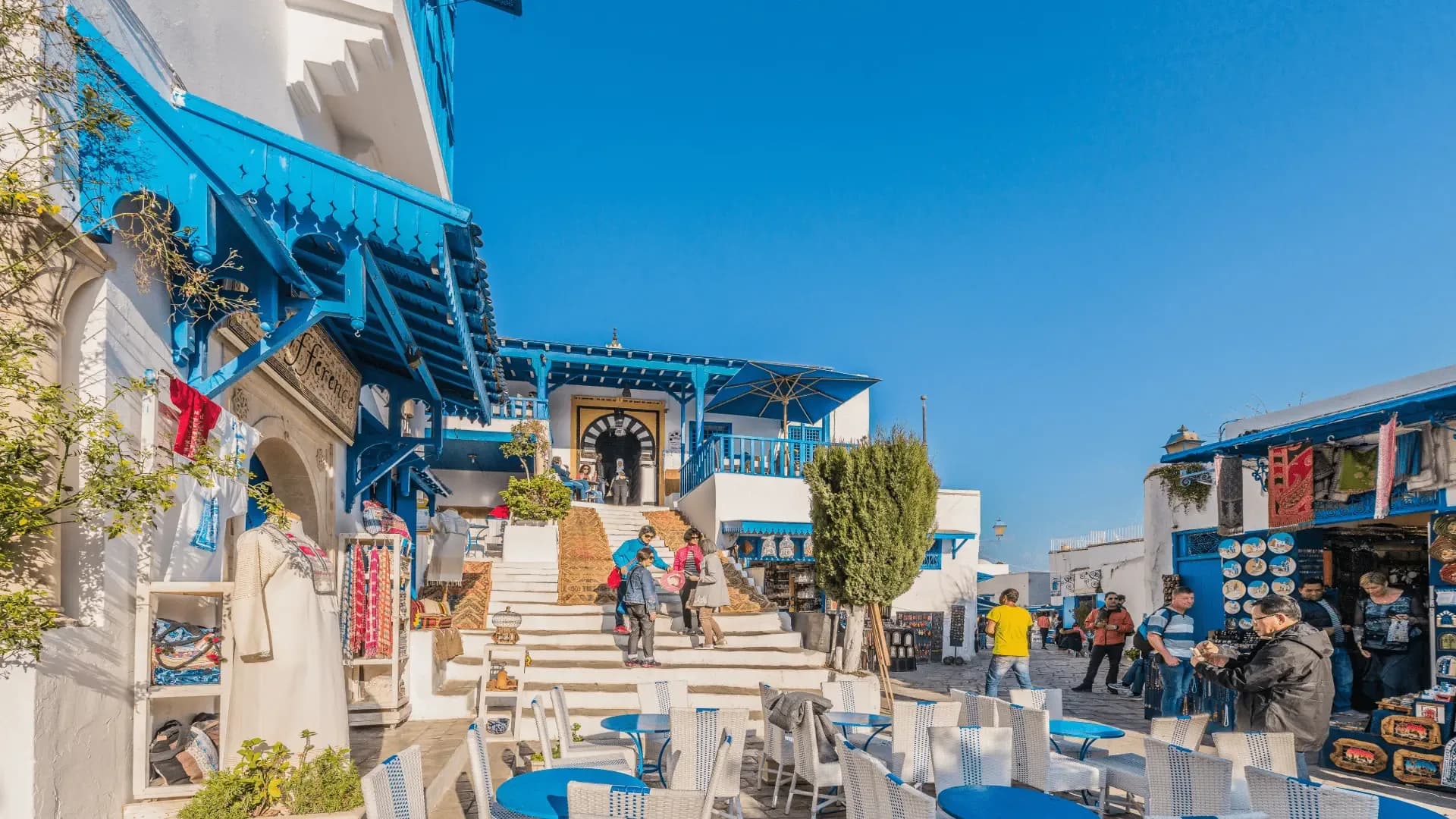
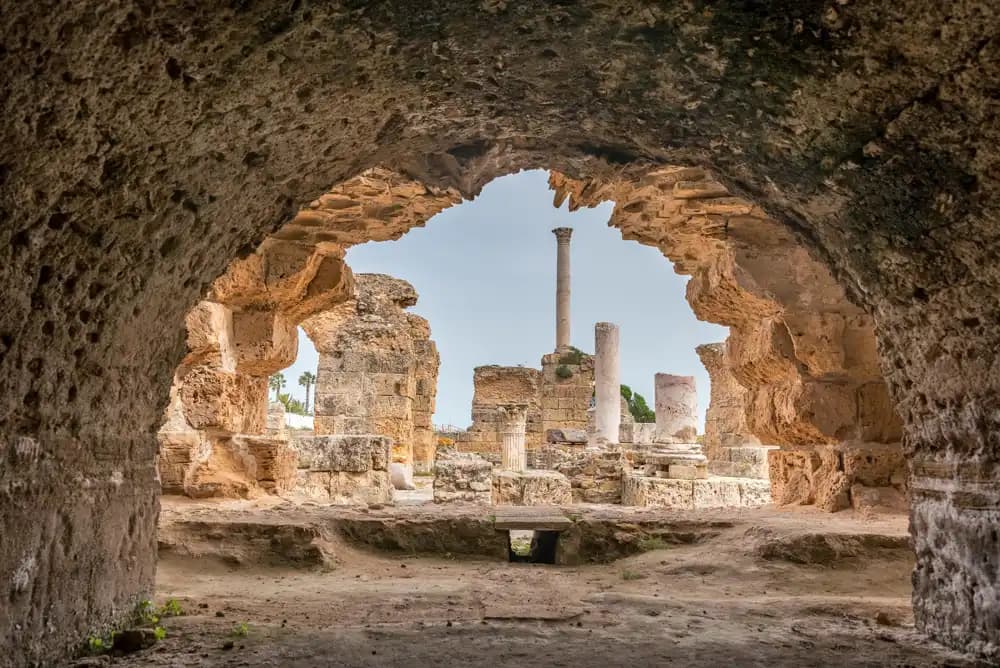
The north centres on Tunis, whose UNESCO medina and souks sprawl like a maze. Nearby are the sea-facing ruins of Carthage, the blue-and-white village of Sidi Bou Said, and the Bardo Museum's world-class mosaics. Inland stand the hilltop Roman town of Dougga and the vast amphitheatre of El Jem. Read the walks — El Jem, Dougga, Carthage.
Where to go ②: the south, the Sahara & Star Wars
Head south and the landscape changes completely. From Douz or Tozeur, you can ride a camel over the dunes and sleep under a blaze of stars at a desert camp. Salt lakes, oases, and the cave village of Matmata round it out — and several sites are famous Star Wars filming locations, making the south a pilgrimage for film fans.
Food in Tunisia
Eating is part of the trip. The national dish is couscous; brik is a crisp fried pastry filled with egg or tuna; and harissa, the fiery chilli paste, turns up everywhere. Tunisian food blends Berber, Arab and Mediterranean flavours, and prices run from street stalls to fine dining.
Culture & what to wear
Tunisia is a Muslim country but a relatively liberal one — one of the most progressive in the region — so there is no need to be anxious. For everyday sightseeing, normal Western clothing is fine. At mosques and religious sites you'll need to cover shoulders and knees, and women should carry a scarf. Alcohol is available in tourist-oriented restaurants and hotels.
Is Tunisia safe? (and solo female travel)
The main tourist areas — Tunis, Sousse, Hammamet, Djerba — sit well outside any advisory zones and are generally safe to travel. As anywhere, take normal care against pickpockets and pushy touts in busy spots. Tunisia is often cited as one of the easier North African countries for solo female travellers; if the logistics or attention feel daunting, a guided circuit with private transfers removes most of the friction.
What to pack & what to wear
Don't forget comfortable walking shoes, sunscreen and a hat — the sites offer little shade and plenty of uneven stone. Pack a scarf for mosque visits, and a warm layer for the desert, where days are hot but nights turn cold. Drink bottled water, and adjust your packing list to the season and where you're headed.
How many days do you need? Planning your trip
As a rule of thumb: 7 days is the minimum for the highlights, 10 days is comfortable, and 14 days lets you go deep into the Sahara. Once you've settled on where and how long, our local team will shape an itinerary around your interests. Start with Plan your trip and tell us what you'd like to see.
Frequently asked questions
Is Tunisia safe to visit?
The main tourist regions are generally safe to travel, sitting outside advisory zones. Take normal precautions against pickpockets and touts; a guided circuit with transfers adds peace of mind for solo or first-time travellers.
Do I need a visa for Tunisia?
Citizens of the US, UK, EU and many other countries can enter visa-free for up to 90 days as tourists. Keep your passport valid for at least six months and check the rules for your nationality.
How much does a trip to Tunisia cost?
Tunisia is one of the cheapest Mediterranean destinations; day-to-day costs are low and the connecting flight is the biggest expense. An all-in circuit makes the total easy to predict.
What is the best time to visit Tunisia?
Spring (April–June) and autumn (September–November) for sightseeing and the desert; July–August for the beach. Winter is mild and quiet but the sea is too cold to swim.
How many days do you need in Tunisia?
Seven days for the highlights, ten to be comfortable, and fourteen to include the deep Sahara.
What should I wear in Tunisia?
Normal clothing for sightseeing; cover shoulders and knees at mosques (a scarf helps for women); and pack a warm layer for cold desert nights.