

Tunisia rewards both the independent wanderer and the traveller who wants everything handled — the right choice comes down to how you value your time, comfort, and peace of mind.
If you have plenty of time, a modest budget, and enjoy sorting out transport and language on the fly, Tunisia is very doable independently. If your days are limited, you want to see a lot without stress, or you simply prefer someone else to drive the long desert distances and open doors for you, a private tour with a car, driver, and licensed guide is the more comfortable and often more efficient way to travel.
Prefer to watch first? This short clip gives a feel for travelling in Tunisia:
The quick verdict on tours versus going it alone
There is no single right answer, and anyone who tells you otherwise is selling something. Tunisia is a compact, friendly country where independent travel genuinely works — yet it is also a place of long distances between headline sights, patchy public transport once you leave the coast, and a lot of history that only comes alive with a knowledgeable guide beside you.
Three questions decide it for most people: how much time do you have, how much comfort do you want, and how confident are you with French or Arabic? The more pressed, the more comfort-seeking, or the less multilingual you are, the more a private tour earns its keep. If you have two or three relaxed weeks and like the puzzle of travel logistics, independent travel can be a joy — and cheaper. Below we lay out the honest trade-offs so you can choose with open eyes.
Should I book a tour for Tunisia or travel independently?
Book a tour if your trip is short (roughly a week to ten days), you want to combine coast, Roman sites, and the Sahara without juggling transfers, or you would rather absorb the history than navigate it. Travel independently if you have ample time, a tight budget, strong French, and you enjoy improvising.
Many visitors land somewhere in between: independent in the walkable coastal towns, guided for the big-distance days out to the desert or the Roman interior. That hybrid is perfectly sensible and very common.
What a private tour actually includes
"Private tour" sounds grand, but in Tunisia it usually means a practical, door-to-door package built around you rather than a fixed coach departure. A well-run private trip with an agency like Atlantis Voyages typically bundles the following:
- Private car and driver — air-conditioned vehicle, your own schedule, no waiting for a group. The driver handles the long legs between, say, Tozeur and Kairouan, so you arrive rested.
- Licensed English-speaking guide — essential at layered sites like Carthage or Dougga, where the stones say little without context. Guides in Tunisia are state-licensed, which is a meaningful quality bar.
- Accommodation — booked and confirmed along the route, matched to your budget band from comfortable mid-range to upscale.
- Logistics and sequencing — the itinerary is ordered to minimise backtracking, with entrance arrangements, timings, and the occasional reservation handled for you.
What is usually not included: international flights, some meals, personal spending, and tips. A good operator is clear about this up front, which is why a written, itemised quote matters more than a headline figure.
What is the difference between a private guide and a driver in Tunisia?
They are two different roles and the distinction matters. A driver gets you safely and comfortably between destinations but is not licensed to guide inside monuments or give historical commentary. A licensed guide interprets the sites, manages access, and often tailors the day to your pace and interests.
On a full private tour you generally get both — a driver for the road and a guide for the sites — though some trips use a single driver-guide for lighter itineraries. If deep history is your priority, confirm that a licensed guide is included at the key cultural stops.
Is it genuinely cheaper to travel independently
Often yes, but not always, and the gap is smaller than people assume once you count everything. Independent travel saves the agency margin and the cost of a dedicated car and guide. Against that, you spend more time arranging things, you pay retail for each transfer and hotel, and inefficient routing can quietly add nights and fuel.
A private tour's value is concentrated in time, comfort, and the invisible costs independent travellers absorb — the half-day lost to a cancelled connection, the premium paid for a last-minute room, the sight skipped because getting there was too hard. For a fuller picture of what shapes a Tunisia budget, see our Tunisia trip cost guide.
| Factor | Independent travel | Private tour |
|---|---|---|
| Headline cost | Usually lower | Higher, but all-in |
| Planning effort | High — on you | Low — handled for you |
| Time efficiency | Variable | High |
| Comfort on long drives | Depends on transport | Consistent, private car |
| Depth at historic sites | Self-guided | Licensed guide |
| Flexibility to change plans | Total | High, within the booking |
| Language friction | Can be significant | Minimal |
Is a package tour of Tunisia worth the money?
For most first-timers on a limited schedule, yes. The money buys back your time and removes friction — you are not researching bus timetables at breakfast or haggling for a taxi to a remote ruin. The experience is also richer, because a guide turns a pile of Roman stones into a story.
It is less obviously worth it if you have weeks to spare, speak the language, and treat the logistics as part of the adventure. In that case the savings and spontaneity of independent travel may matter more to you than the convenience.
How easy is Tunisia to travel on your own
Easier than many assume, with real caveats. Tunisia is small, people are welcoming, and the main coastal corridor is well connected. The louage (shared minibus) network reaches almost everywhere cheaply, and trains link Tunis with the coast. The friction appears in three places.
Distances and routing. The star attractions are spread out — Tunis and Carthage in the north, the Roman amphitheatre at El Jem in the centre, and the Sahara gateways of Tozeur, Douz, and Matmata in the south. Stitching these together independently eats time. Our guide to how many days you need in Tunisia shows just how quickly the map adds up.
Transport beyond the coast. Public options thin out as you head inland and south. Reaching remote sites like the desert oasis of Ksar Ghilane or the mountain oases near Tamerza usually means hiring a car with a driver anyway.
Language. Arabic and French dominate; English is common in tourist hubs but thins out in smaller towns. A little French goes a long way, and its absence is where independent travellers most often feel stuck.
Is Tunisia easy to travel independently?
Along the coast — Tunis, Sousse, Djerba — it is quite easy, with reliable transport and plenty of English in tourist areas. Inland and in the south it becomes harder, with longer distances, fewer services, and more reliance on French or Arabic.
If you only plan to base yourself in one coastal town and take the occasional day trip, independent travel is straightforward. If you want to loop through the Roman interior and the desert, the logistics tilt firmly towards hiring transport or booking a guided trip.
Do people speak English in Tunisia?
In hotels, resorts, and the main tourist sites, yes — enough to get by comfortably. Away from those, Arabic and French take over, and English becomes patchy. This is the single biggest practical reason travellers opt for an English-friendly private tour: it removes the daily translation effort and makes negotiating, directions, and the fine print effortless.
Group tour versus private tour
Not all tours are equal, and the choice between a fixed-departure group coach and a private arrangement changes the experience completely. A group tour is the cheapest guided option: you join a set itinerary with a fixed schedule and a shared coach. A private tour is built around you — your dates, your pace, your interests — with a car and guide dedicated to your party.
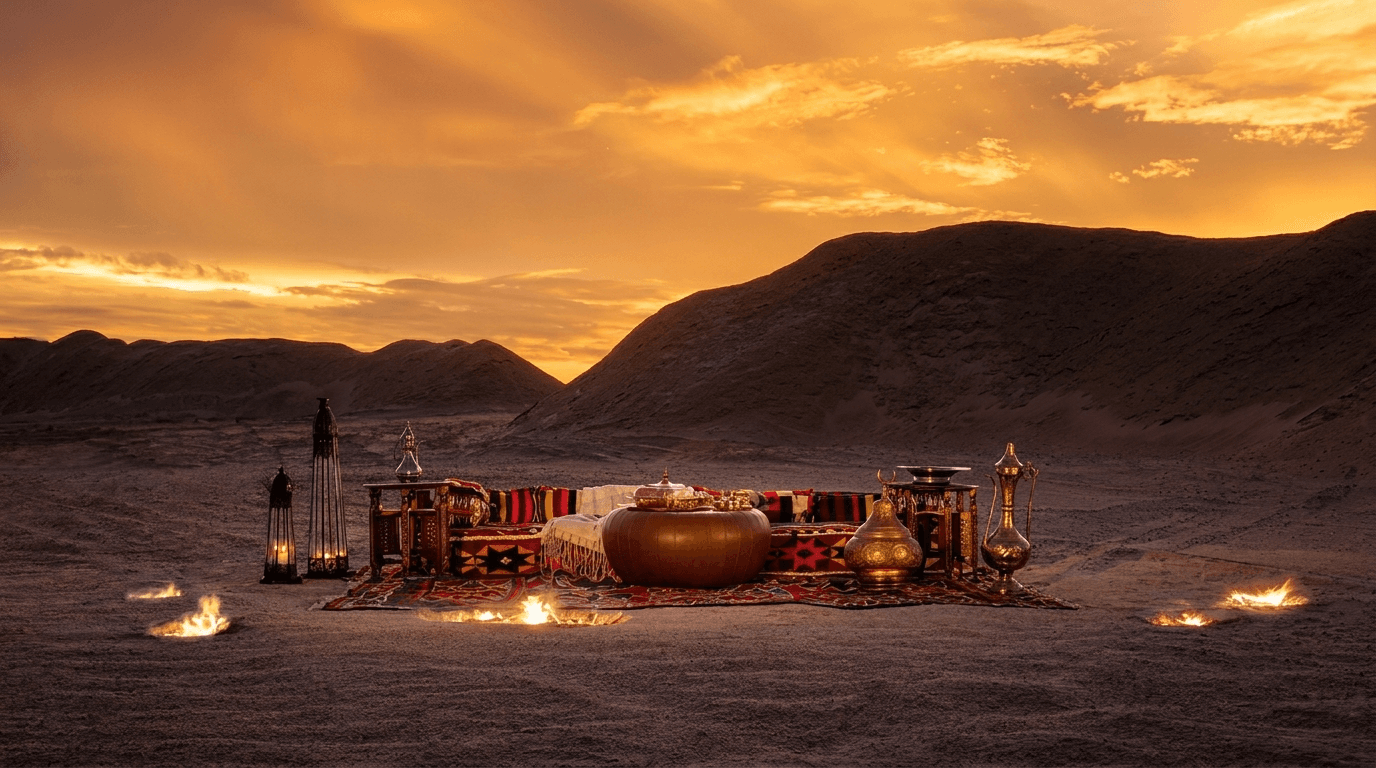
Group tours suit budget-minded travellers who do not mind a set pace and enjoy the company of others. Private tours suit those who want flexibility: a longer morning at Kairouan, a detour to a weaver's workshop, a slow afternoon in the blue-and-white streets of Sidi Bou Saïd, or an unhurried desert sunset near Douz. You pay more for that freedom, but you control the day.
What is better for Tunisia, a group tour or a private tour?
Choose a group tour if cost is the deciding factor and you are comfortable following a fixed schedule with other travellers. Choose a private tour if you want to set your own pace, travel with just your own party, and tailor the route to what interests you.
Couples, families, small groups of friends, and anyone with specific interests — Roman history, photography, desert landscapes — usually find the private option a far better fit despite the higher price.
Who each option suits best
Rather than argue for one side, match the option to the traveller. The honest summary:
- First-time visitors on a week to ten days — private tour. You see the highlights without losing days to logistics.
- Budget backpackers with weeks to spare — independent. Time and flexibility are on your side, and the louage network is cheap.
- Couples and families wanting comfort — private tour. Door-to-door ease, child-friendly pacing, no transport stress.
- Confident French-speakers who love planning — independent, with perhaps a guide hired for the desert leg.
- Older travellers or anyone prioritising ease — private tour. The long drives and site access are handled for you; see our seasonal notes for senior travellers.
- History-focused travellers — private, for the licensed guide who makes Dougga and Sbeitla come alive.
Is it safe to travel independently in Tunisia?
Tunisia is generally welcoming to visitors, and many people travel independently without incident. As anywhere, use normal precautions, keep an eye on current advice, and stay aware in crowded areas and when arranging transport. We cover this in depth in our guide to whether Tunisia is safe to visit.
For the latest official position, always check your own government's travel advisory and confirm any entry or health requirements with the Tunisian authorities or your embassy before you book. A reputable operator will also brief you on current conditions as part of planning your trip.
How far in advance should you book a private tour of Tunisia?
For high season — spring and autumn, plus summer on the coast — booking six to eight weeks ahead gives the widest choice of guides, vehicles and accommodation, though a good operator can often arrange shorter-notice trips too. Because a private tour is built around your own dates and interests, the earlier you start the conversation, the more the itinerary can be tailored to you.
The process is simple: share your dates, how many days you have, the regions you care about and your comfort band, and you will receive a realistic, itemised plan rather than a fixed brochure price.
How to get a tailor-made quote
If the private route appeals, the next step is a realistic, itemised quote rather than a glossy brochure price. Tell an operator your dates, how many days you have, the regions you care about, your comfort band, and any must-sees, and a good one will build a route around them.
This is exactly how Atlantis Voyages works: a local, English-friendly team arranging private car, driver, and licensed guide, door to door, so you experience the country rather than wrestle with it — without pretending independent travel is impossible, because for the right traveller it is wonderful. When you are ready to compare a concrete plan against doing it yourself, you can plan your trip and get a personalised itinerary and quote with no obligation.
Still new to Tunisia and weighing it up, you can start with our first-time visitor FAQ and our overview of getting to Tunisia, then plan your trip when the shape of your ideal journey becomes clear. Whichever way you choose to travel, Tunisia is ready for you.