
Carthage was razed and rebuilt by Rome — but one Punic town on the tip of Cap Bon was abandoned and never touched again, and today it is the only place on earth where you can walk the streets of a Phoenician-Punic city exactly as its people left them.
Kerkouane is a Punic town on Tunisia's Cap Bon peninsula, abandoned around 255 BC during the First Punic War and never rebuilt. Because the Romans never built over it, it preserves its original grid of streets, its houses — and, most famously, a private pink-plastered bathroom in almost every home. It has been a UNESCO World Heritage Site since 1985 (the necropolis added in 1986) and is one of the quietest, most atmospheric ancient sites in the Mediterranean.
What is Kerkouane?
Kerkouane sits on a low rise above the sea at the north-eastern tip of the Cap Bon peninsula, the fertile horn of land that reaches out from north-eastern Tunisia towards Sicily. It was a modest but prosperous Phoenician-Punic town — part of the world dominated by Carthage — that flourished from roughly the 6th to the 3rd century BC. At its height it held perhaps 300 houses and around 2,000 people, living from fishing, farming the rich Cap Bon soil, pottery, and above all the famous Phoenician purple dye extracted from murex sea-snails.
Its modern name, Kerkouane, is simply the name of the area; the town's original Punic name has been lost. What makes it extraordinary is not its size but its completeness — and the reason for that completeness is a quirk of history.
Why Kerkouane is unique: the only unspoiled Punic town
Almost everything we can see of Carthaginian civilisation has been filtered through Rome. Carthage itself was destroyed in 146 BC and then rebuilt as a Roman metropolis, so its Punic layers survive only in fragments beneath the later city. Nearly every other Punic settlement met the same fate. Kerkouane is the exception.
The town was abandoned during the First Punic War, around 255 BC, when a Roman expedition ravaged Cap Bon — and it was never reoccupied, and never built over. The result is the only known Phoenician-Punic town preserved in its original state, without Roman streets, Roman temples or Roman houses laid on top. Walking Kerkouane is as close as you can get to seeing how ordinary Carthaginians actually lived, rather than how Rome later remembered them. That is exactly why UNESCO inscribed it, and why it matters far beyond its quiet size.
What to see at Kerkouane
Kerkouane is compact and easy to walk, but the detail rewards a slow visit. Here is what to look for.
The grid of streets and the double walls
The town was laid out on an orderly grid plan, with streets meeting at right angles and opening onto small squares — sophisticated urban planning for its day. It was protected by a double defensive wall, traces of which you can still follow. Walking the lanes, you move between house after house whose ground-floor walls still stand waist- to shoulder-high, so the shape of the town is immediately legible.
The pink bathrooms — comfort 2,300 years ago
Kerkouane's signature feature, and the thing visitors remember, is its bathrooms. Almost every house had its own private bathroom with a built-in hip-bath (a sit-down tub), finished in a smooth, water-resistant pink-red plaster. Some even had a seat and a footrest moulded into the bath. For a town of 2,000 people more than two thousand years ago, this level of everyday domestic comfort and hygiene is remarkable — and it is beautifully preserved here in a way it is nowhere else.
The houses and the Sign of Tanit
The houses were built around small interior courtyards, with rooms arranged for privacy and shade. Floors were often finished in opus signinum — a tough red mortar studded with chips of white marble — and in one celebrated example a floor is decorated with the Sign of Tanit, the emblem of the great Carthaginian goddess, picked out in white against the red. It is a small, moving detail: a household placing the protection of its goddess underfoot.
Workshops and the purple-dye trade
Kerkouane was a working town. Excavations have uncovered pottery workshops and kilns, and abundant evidence of the production of Tyrian purple — the rare, prized dye extracted from crushed murex shells that made Phoenician cities wealthy across the Mediterranean. Tyrian purple was so laborious to produce — thousands of snails for a few grams of dye — that it was worth a fortune and became the colour reserved for royalty and high office across the ancient world. The heaps of shells and the dye workshops are a reminder that this was not a monumental capital but a prosperous craft-and-trade community.
The site museum and the necropolis
A small, well-arranged on-site museum displays the finds — pottery, jewellery, statuettes, tools and everyday objects — that bring the houses to life, including a famous carved sarcophagus lid. A short distance away lies the necropolis, with rock-cut tombs; it was added to the UNESCO listing in 1986. Together, town and cemetery give you both halves of Punic life.
The story: how Kerkouane ended
Kerkouane's end came with the first great clash between Carthage and Rome. During the First Punic War (264–241 BC), a Roman army under the consul Regulus landed on Cap Bon in 256–255 BC and devastated the region. Kerkouane was damaged and then abandoned by its inhabitants, who never returned. Unlike Carthage — which Rome would utterly destroy a century later and then rebuild — Kerkouane was simply left to the sand and the sea, and the town was rediscovered and excavated only from the 1950s onward, emerging almost intact after more than two thousand years. That abandonment is a tragedy for the people who fled, but it is the reason the town survived intact for us to see.
How to visit Kerkouane
Kerkouane lies on the Cap Bon peninsula, near the towns of Kelibia and El Haouaria, roughly a 1.5–2 hour drive from Tunis. Public transport does not reach the site directly, so the easiest way to visit is with a car or a private driver-guide.
- Time needed: allow about 1.5–2 hours for the town and the museum.
- Entry: inexpensive — a few Tunisian dinars; bring small cash (see our dinar money guide).
- Combine it: make a full Cap Bon day of it — the Byzantine fort and beaches of Kelibia, the sea caves of El Haouaria, and the wine and ceramics of the peninsula.
- When to go: spring and autumn are ideal; the exposed coastal site is hot in high summer. See our best time to visit Tunisia guide.
Because it is off the main tourist trail, you will often have the ruins almost to yourself — with the blue of the Mediterranean on one side and 2,300-year-old streets at your feet.
Kerkouane in Tunisia's Punic and Roman story
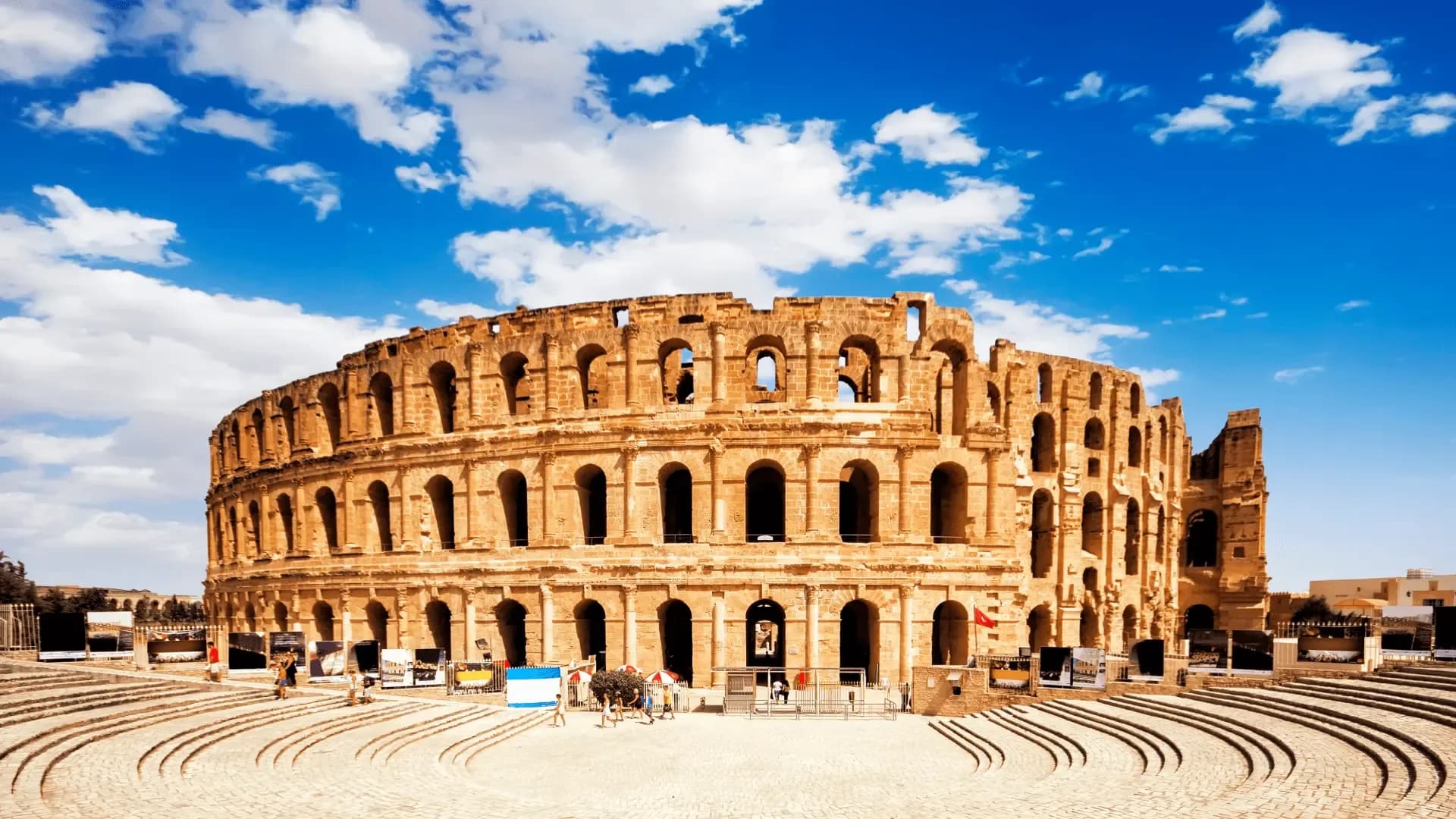
Kerkouane is best understood alongside the rest of Tunisia's ancient sites. Where Kerkouane shows you Punic daily life, Carthage shows the Punic-then-Roman capital, and the great Roman monuments — the amphitheatre of El Jem and the complete hilltop town of Dougga — show what came after. Many of the finest objects from all of these sites, including Punic stelae and the world's richest collection of Roman mosaics, are gathered in the Bardo Museum in Tunis. Kerkouane is one of Tunisia's ten UNESCO World Heritage Sites — see them all in our complete guide to UNESCO sites in Tunisia, or start with our guide to Carthage.
Together they tell a single story — Phoenician, Carthaginian, Roman — and Kerkouane is the irreplaceable first chapter. Atlantis Voyages can fold Kerkouane and Cap Bon into a tailor-made itinerary: browse our Tunisia tours or start planning your trip.
Frequently asked questions
What is Kerkouane famous for?
It is the only Phoenician-Punic town never rebuilt by the Romans, so it preserves its original streets and houses — most famously a private, pink-plastered bathroom in almost every home.
Where is Kerkouane in Tunisia?
On the north-eastern tip of the Cap Bon peninsula, near Kelibia and El Haouaria, about 1.5–2 hours by road from Tunis.
Why were the Romans never at Kerkouane?
The town was abandoned around 255 BC during the First Punic War and simply never reoccupied — so, unlike Carthage, it was never built over by a later Roman city.
When was Kerkouane made a UNESCO World Heritage Site?
The town was inscribed in 1985, and its necropolis was added to the listing in 1986.
What are the famous bathrooms of Kerkouane?
Almost every house had a private bathroom with a built-in hip-bath finished in water-resistant pink-red plaster — a striking sign of everyday comfort more than 2,000 years ago.
How long do you need to visit Kerkouane?
About 1.5 to 2 hours to see the town and the small on-site museum unhurried.
How do you get to Kerkouane?
By car or private driver from Tunis (around 1.5–2 hours via Cap Bon). There is no direct public transport to the site.
How much does it cost to enter Kerkouane?
Entry is inexpensive — a few Tunisian dinars, paid in cash at the gate.
What can you combine with a visit to Kerkouane?
Make a full Cap Bon day: the fort and beaches of Kelibia, the sea caves of El Haouaria, and the peninsula's wine and ceramics.
Is Kerkouane worth visiting?
Yes — for anyone interested in the Carthaginians it is unmissable and unlike any other site in the country: quiet, by the sea, and utterly authentic.
What was Kerkouane's economy based on?
Fishing and farming, pottery, and above all the production of Tyrian purple dye from murex sea-snails — a luxury prized across the ancient Mediterranean.
What does "Punic" mean?
"Punic" refers to the Carthaginians and their civilisation — the western Phoenicians who settled North Africa from around the 9th century BC and built Carthage into a Mediterranean power. Kerkouane is a Punic town, not a Roman one.
Is Kerkouane the same as Carthage?
No. Both were Punic, but Carthage was the great capital (later destroyed and rebuilt by Rome), while Kerkouane was a smaller coastal town on Cap Bon that was abandoned and left untouched — which is why its Punic houses survive so completely.
Can you see the sea from Kerkouane?
Yes — the site sits right above the Mediterranean on the Cap Bon coast, and its setting is one of the quietest and most scenic of any ancient site in Tunisia.
Walk a Punic town exactly as it was left. Plan a tailor-made Tunisia trip with Atlantis Voyages, or explore our guided Tunisia tours.