
With ten UNESCO World Heritage Sites packed into a country you can cross in a single day's drive, Tunisia is one of the richest — and least crowded — open-air history lessons in the Mediterranean.
As of 2026, Tunisia has 10 UNESCO World Heritage Sites — nine cultural and one natural (Ichkeul National Park). They span the Punic and Roman ruins of Carthage, El Jem, Dougga and Kerkouane, the living Islamic medinas of Tunis, Sousse and Kairouan, the wetlands of Ichkeul, and the two newest additions — the island of Djerba (2023) and the blue-and-white village of Sidi Bou Saïd (2026).
How many UNESCO World Heritage Sites does Tunisia have?
Tunisia has ten inscribed sites — an astonishing number for such a compact country, and more than many far larger nations. Nine are cultural and one, Ichkeul, is natural. Here is the complete list with each site's year of inscription:
- Amphitheatre of El Jem — full guide — 1979 (cultural)
- Archaeological Site of Carthage — 1979 (cultural)
- Medina of Tunis — 1979 (cultural) — full guide
- Ichkeul National Park — 1980 (natural)
- Punic Town of Kerkuane and its Necropolis — 1985 (cultural)
- Kairouan — 1988 (cultural) — full guide
- Medina of Sousse — 1988 (cultural)
- Dougga / Thugga — 1997 (cultural) — full guide
- Djerba — 2023 (cultural) — full guide
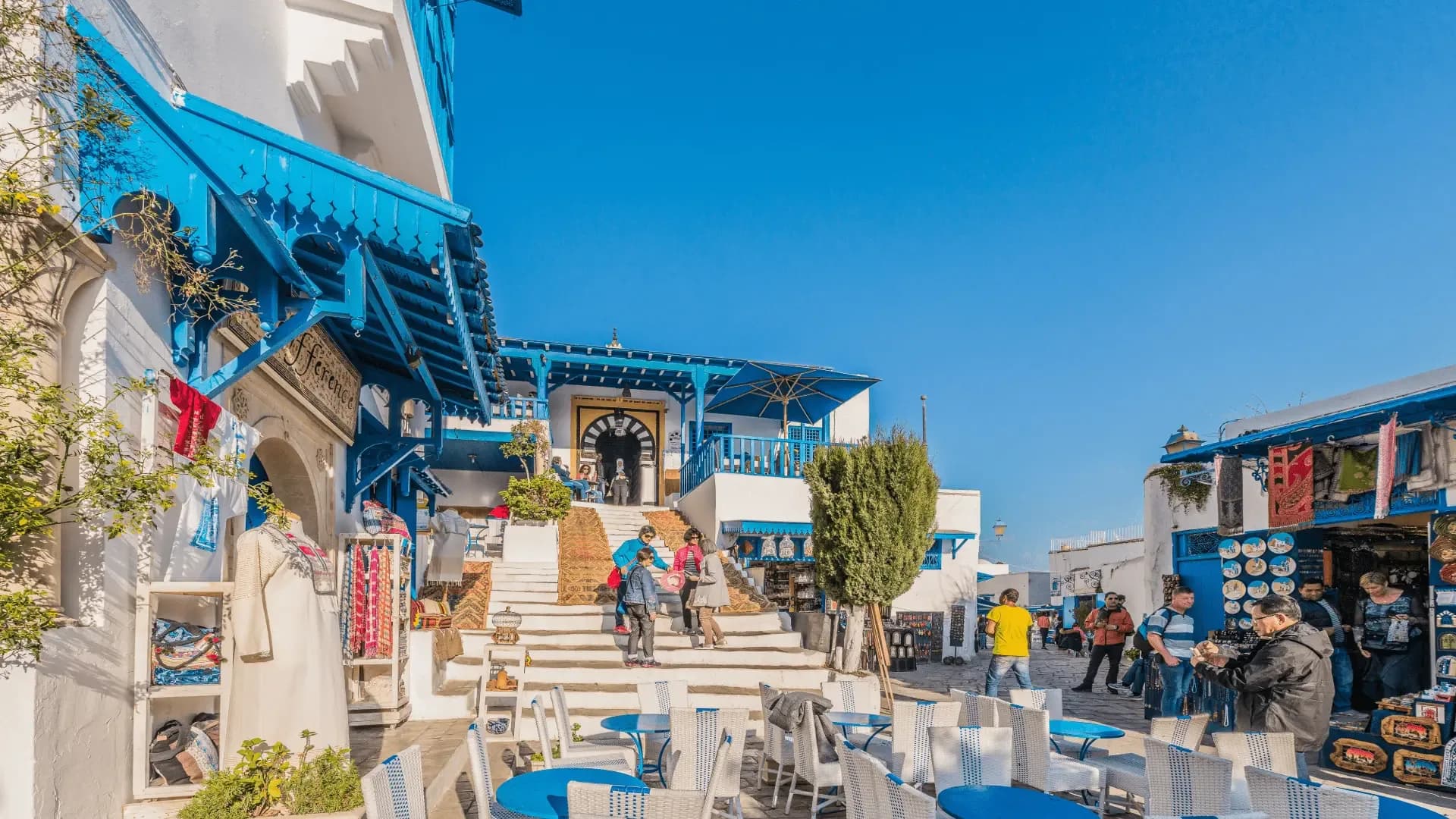
- Village of Sidi Bou Saïd — 2026 (cultural)
The sites fall naturally into four groups — the ancient Punic and Roman cities, the living Islamic medinas, the one natural reserve, and the recent "living heritage" listings. We'll take them in turn, with what to see and how to reach each one.
The ancient world: Punic and Roman Tunisia
Two thousand years ago this was the breadbasket of Rome — the wealthy province of Africa Proconsularis. Because many of its towns were later abandoned rather than built over, Tunisia preserves some of the finest ancient sites in the world, often with hardly another visitor in sight.
Archaeological Site of Carthage
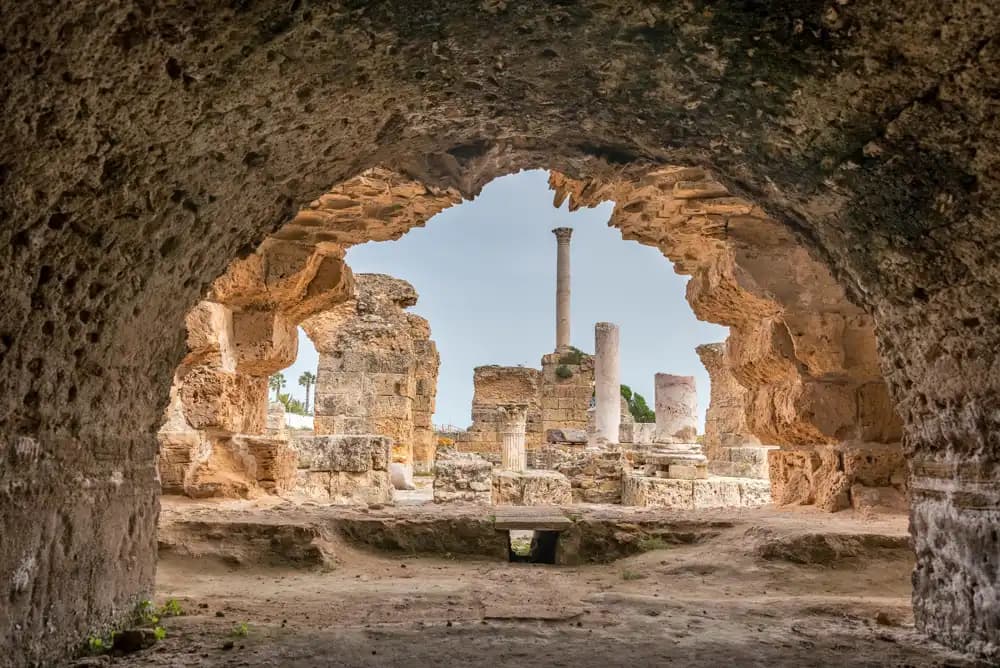
Founded by Phoenician settlers and later Rome's most dangerous rival, Carthage was destroyed in 146 BC at the end of the Third Punic War, then rebuilt as one of the grandest cities of the Roman Empire. The site is spread across the seaside suburbs of Tunis, so it's best seen with a little planning: the Antonine Baths (the largest Roman baths outside Rome) on the shore, the circular Punic ports, the Tophet sacred precinct, and Byrsa Hill with the National Museum of Carthage; its greatest mosaics are gathered in the Bardo Museum in Tunis. The TGM light-rail line links the main sites to central Tunis in about half an hour. Allow a half to a full day, and read our complete guide to Carthage to plan the route.
Amphitheatre of El Jem
Rising out of a quiet market town, the amphitheatre of El Jem is one of the largest and best-preserved in the entire Roman world — built in the 3rd century AD to seat tens of thousands. You can walk the arena floor, climb the surviving tiers and descend into the underground corridors where gladiators and animals once waited. The small archaeological museum nearby holds superb mosaics. El Jem sits on the main route south (about 60 km from Sousse, roughly 200 km from Tunis) and is easy to fold into a journey between the coast and the interior; in summer it hosts an acclaimed international symphonic festival under the stars.
Dougga (Thugga)
Often called the best-preserved small Roman town in North Africa, Dougga sprawls across a green hillside with views over the Tébessa plains. Unlike a single monument, this is a whole city: the Capitol still standing nearly complete, a theatre cut into the slope, temples, baths, latrines and a striking Libyco-Punic mausoleum. The site covers around 65 hectares, so allow half a day to walk it unhurried. It lies about 100 km (roughly two hours) from Tunis and pairs beautifully with the underground Roman villas of nearby Bulla Regia.
Punic Town of Kerkuane
On the tip of the Cap Bon peninsula, Kerkouane is unique in the world: the only Phoenician-Punic town that was never rebuilt by the Romans. Abandoned during the First Punic War in the 3rd century BC and never reoccupied, it preserves its original street grid, drainage, and — most memorably — private bathrooms with hip-baths finished in red-ochre plaster, showing a standard of domestic comfort rarely seen in the ancient world. The site, with its necropolis, was inscribed in 1985–86. It is quiet, atmospheric and well off the standard trail.
The living medinas: Islamic Tunisia
Three of Tunisia's World Heritage Sites are not ruins at all but living cities, lived and traded in exactly as they have been for a thousand years.
Medina of Tunis
The Medina of Tunis grew up around the Zitouna (Ez-Zitouna) Mosque from the 8th century and holds some 700 monuments — mosques, madrasas, palaces, mausoleums and fountains — threaded by covered souks selling perfume, gold, leather and chèchias. It remains the beating heart of the capital. Lose yourself for a morning in the lanes, then emerge onto the colonial Avenue Habib Bourguiba. It was among Tunisia's first three sites, inscribed in 1979.
Kairouan
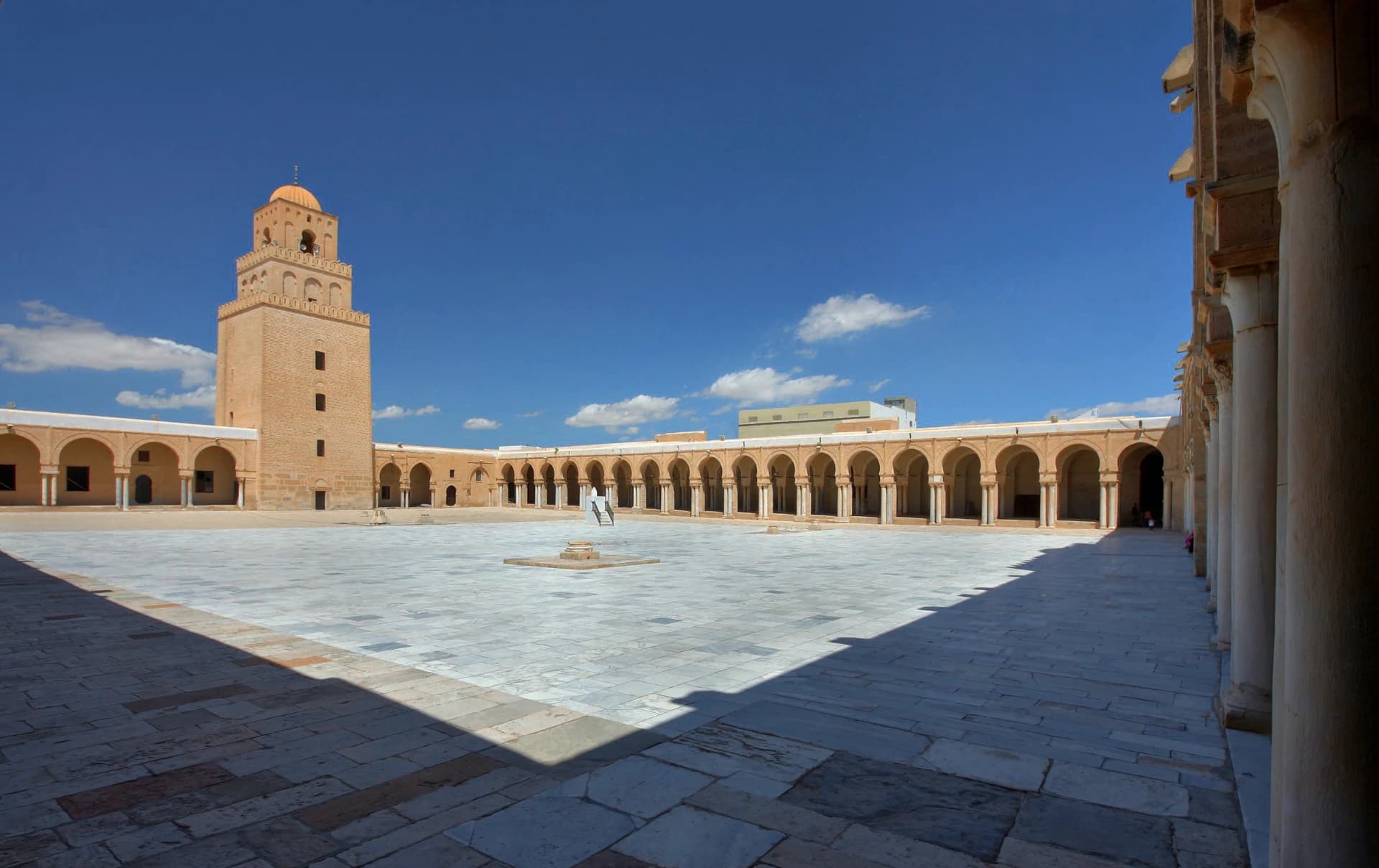
Founded in 670 AD, Kairouan was the first great Muslim city in the Maghreb and is regarded by many as the fourth holiest city of Islam. Its Great Mosque — one of the oldest and most influential in the Islamic world — set the template for mosque architecture across North Africa. Add the Aghlabid water basins, the Mosque of the Barber (Zawiya of Sidi Sahib) and the medina's famous carpet workshops. Non-Muslim visitors can usually admire the Great Mosque's vast courtyard if they dress modestly and come outside prayer times. Inscribed in 1988.
Medina of Sousse
The Medina of Sousse is a textbook example of an early Islamic coastal town, fortified against sea raids. Its Ribat (a fortified monastery) and Great Mosque date from the 9th century, and the kasbah and ramparts still enclose a busy medina. The "Pearl of the Sahel" also makes a convenient base for the coast and for El Jem, 45 minutes away. Inscribed in 1988.
Nature and living landscapes
Not every site is built of stone. Three of the ten honour landscapes and the way people and nature have shaped them.
Ichkeul National Park
In the far north near Bizerte, Ichkeul is Tunisia's only natural World Heritage Site — a lake, marshes and a limestone massif that together form one of the most important wintering grounds in the Mediterranean for migratory waterbirds, with hundreds of thousands of ducks, geese, flamingos and storks passing through. It is a destination for birdwatchers and walkers rather than monument-hunters, best in late autumn and winter. Inscribed in 1980.
Djerba
The southern island of Djerba was inscribed in 2023 for a different kind of heritage: its settlement pattern. Over centuries of adapting to scarce water, Djerbans spread their fortified farmhouses (menzels), underground cisterns, mosques and markets thinly across the island rather than clustering in one town — a distinctive, sustainable way of living that UNESCO recognised as outstanding. Djerba is also home to the El Ghriba synagogue and one of North Africa's oldest Jewish communities, and rewards a longer, slower, beach-and-culture stay.
Village of Sidi Bou Saïd
Tunisia's newest listing (2026), Sidi Bou Saïd is the famous blue-and-white village perched on a cliff above the Gulf of Tunis, next to Carthage. Its whitewashed houses, blue doors and studded shutters, jasmine-scented lanes and clifftop cafés have drawn painters — Paul Klee and August Macke among them — for over a century. Pair it with Carthage for a perfect half-day from Tunis, ideally late afternoon when the light turns gold and the day-trippers thin out.
Planning a UNESCO trip to Tunisia
A few practical notes make the difference between a rushed checklist and a trip you remember.
- Tickets: entry to most sites is modest — typically a few dinars, with the headline sites (El Jem, Carthage, Dougga) a little more. Carry small cash in Tunisian dinars; see our dinar money guide.
- Getting around: the sites are spread across the country and public transport rarely reaches the ruins themselves. A private driver-guide turns long transfers into easy, informative days and is how most visitors travel.
- A guide helps: on-site signage is limited at many ruins, so a knowledgeable guide — or a guided itinerary — adds enormously to places like Dougga, Kerkouane and Carthage.
- When to go: spring (March–May) and autumn (September–November) are ideal; summer can top 40 °C inland. See our best time to visit Tunisia guide.
You can see the headline sites — Carthage, Sidi Bou Saïd, the Medina of Tunis, El Jem, Kairouan and Dougga — in a well-planned 4 to 5 days. Adding Sousse, Kerkouane, Ichkeul and Djerba turns it into a rich 7 to 10-day circuit. Atlantis Voyages can build a tailor-made UNESCO itinerary — browse our Tunisia tours or start planning your trip.
Which sites should you prioritise?
If time is short, start with the cluster around the capital: Carthage and Sidi Bou Saïd together as a half-day, plus the Medina of Tunis. Then take El Jem on the way south and Kairouan and Dougga as day trips. Sousse slots in along the coast. Save Kerkouane (archaeology lovers), Ichkeul (nature and birds) and Djerba (island culture and beaches) for a longer stay. However you plan it, Tunisia's great advantage is that even its star sites stay blissfully uncrowded.
Frequently asked questions
How many UNESCO World Heritage Sites are there in Tunisia?
Ten, as of 2026 — nine cultural and one natural. The most recent additions are Djerba (2023) and the village of Sidi Bou Saïd (2026).
What are the UNESCO World Heritage Sites in Tunisia?
Carthage, the Amphitheatre of El Jem, the Medina of Tunis, Ichkeul National Park, Punic Kerkouane, Kairouan, the Medina of Sousse, Dougga, Djerba and Sidi Bou Saïd.
Which is the only natural UNESCO site in Tunisia?
Ichkeul National Park, inscribed in 1980 — a lake and wetland in the north that is a crucial stopover for hundreds of thousands of migratory birds.
What were Tunisia's first UNESCO World Heritage Sites?
Three sites were inscribed together in 1979: Carthage, the Amphitheatre of El Jem and the Medina of Tunis.
Is Carthage a UNESCO World Heritage Site?
Yes. The Archaeological Site of Carthage, just outside Tunis, has been on the list since 1979.
Is Sidi Bou Saïd a UNESCO World Heritage Site?
Yes — the village was inscribed in 2026, Tunisia's newest World Heritage listing.
What is Kerkouane and why is it UNESCO-listed?
Kerkouane is the only Phoenician-Punic town never rebuilt by the Romans. Abandoned in the 3rd century BC, it preserves its original streets and even private bathrooms — a unique window onto everyday Punic life.
Why does Tunisia have so many UNESCO sites?
It was one of the richest provinces of the ancient Mediterranean, and many of its Punic, Roman and early-Islamic towns were abandoned rather than built over — so they survive in exceptional condition.
How much does it cost to visit Tunisia's UNESCO sites?
Entry is inexpensive — usually a few Tunisian dinars per site, with the headline monuments a little more. Bring small cash in dinars, as card payment is rarely available at the gates.
Do you need a guide to visit Tunisia's Roman sites?
You can visit independently, but signage is limited at many ruins, so a guide or a guided itinerary adds a great deal — especially at Dougga, Carthage and Kerkouane.
Are Tunisia's UNESCO sites crowded?
Rarely. Even El Jem and Dougga are peaceful compared with equivalent sites in Europe — one of the great pleasures of travelling here.
Is it worth seeing Roman ruins in Tunisia instead of Italy?
For many travellers, yes: the monuments rival those in Italy, the crowds are a fraction of the size, and you can often walk the sites freely.
Can you visit all of Tunisia's UNESCO sites in one trip?
Yes. A 7 to 10-day circuit with a private driver-guide can cover every mainland site; only Djerba, in the far south-east, adds extra travel time.
How many days do you need to see Tunisia's UNESCO sites?
Around 4 to 5 days for the headline sites near Tunis and the centre, or 7 to 10 days to include Sousse, Kerkouane, Ichkeul and Djerba.
When is the best time to visit Tunisia's UNESCO sites?
Spring (March–May) and autumn (September–November) offer the most comfortable weather for walking the sites; inland summers can exceed 40 °C.
Ready to walk through 3,000 years of history? Plan your tailor-made Tunisia trip with Atlantis Voyages, or explore our guided Tunisia tours.